
HOH Tuesday Speedwork (5.12.26)
Hello!
Hello! Hello!
I hope you all had a lovely weekend
and a Happy Mother’s Day!
I know- you all thought you didn’t
have to put up with me this week, but jokes on you, my flight doesn’t leave
until tomorrow morning. Just enough time to send you the workout Vicky will lead tomorrow evening
😊
Plan to meet her in the LMS Complex parking lot,
ready to get started at 5:45pm!
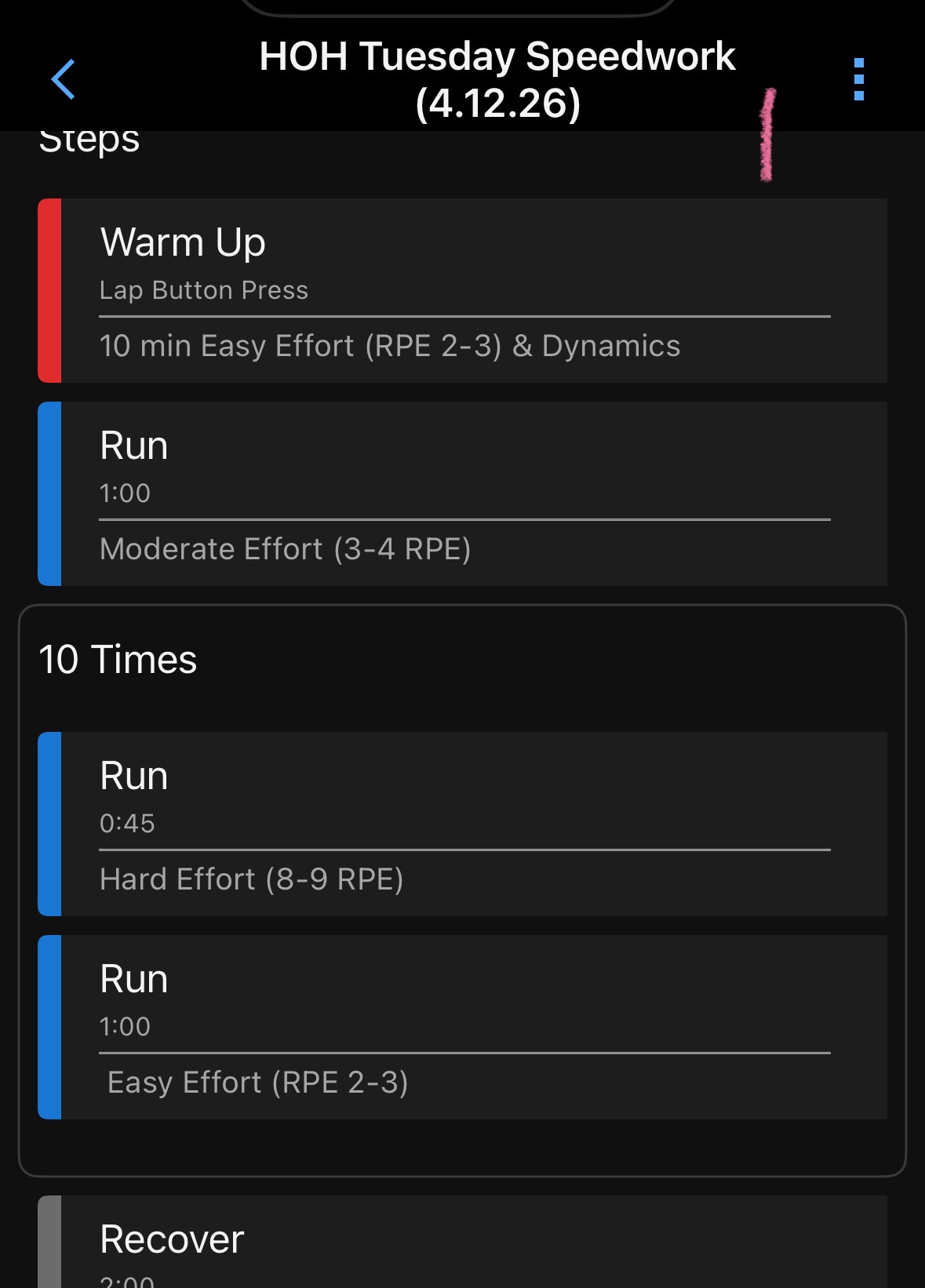
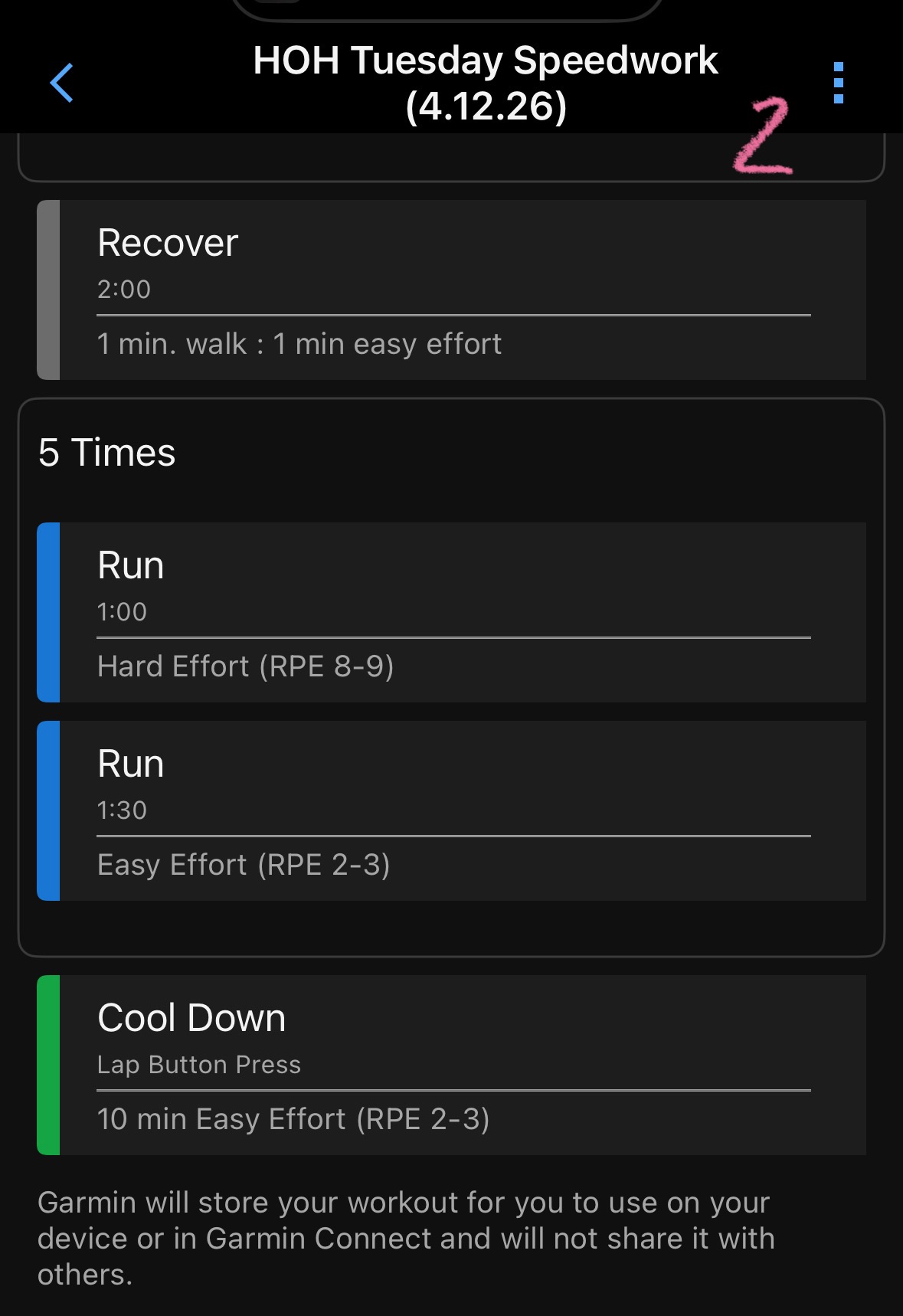
You can find the workout below, along with a screenshot of how I’ve programed
it into Garmin Connect.
Tuesday
Workout (5.12.26):
Warmup: at least 10 min. w/dynamics
1 min. moderate effort (3-4 RPE on a 10-scale)
10 times:
45 sec. hard (8-9 RPE on a 10-scale)/60 sec. easy (2-3 RPE on a
10-scale)
2 min. recovery (1 min. walk/1 min.
easy jog)
5 times:
1 min. hard (8-9 RPE on a 10-scale)/90 sec. easy (2-3 RPE on a
10-scale)
Cooldown: at least 10 min. easy (2-3 RPE
on a 10-scale)
About
the Workout:
- Your warmup and cooldown should be jogged at an easy
effort. - The easy intervals are scheduled as
runs in Garmin Connect, (see screenshot) and should be jogged at an easy effort,
not walked. If
you find yourself needing (not just wanting) to walk, please do so, but
try to only do so for
10-15 seconds. - The 2-minute recovery can be walked
for the first minute and easy jogged for the second. Use this recovery to
adjust your posture and form, regulate your breathing, and sip your water. - EVERYONE should be circling to the back of the group (or as close as possible)
on the easy intervals and recovery. This promotes inclusivity and a team atmosphere.
This will also allow Vicky to check in on everyone.
Tuesdays are supposed to be tough, and you are supposed
to feel uncomfortable during these workouts so don’t phone this workout in!
These short, hard efforts with small
periods of rest between are designed to build your anaerobic threshold. Over
time, running these more intense intervals will help improve your speed and
build your aerobic capacity.
What is Anaerobic Capacity and What is the Benefit?
Anaerobic Capacity is the body’s
ability to produce energy without using oxygen during short durations of high-intensity activities.
Unlike running aerobically which uses oxygen to produce energy for longer
durations (such as your long training runs completed at a conversational pace),
running anaerobically relies on the body to break down carbohydrates (glycogen)
stored in your muscles to produce energy. This energy production process
creates lactic acid, a byproduct which can cause muscle fatigue and soreness.
By training your anaerobic capacity,
you help your body become more efficient at handling that lactic acid buildup
which will then delay muscle fatigue (while running); allowing you to build up
endurance and push harder for longer periods of time. Building your endurance
also improves your VO2max (the amount of oxygen used while exercising),
allowing you to increase your cardiac fitness and pace. These improvements help
you become a more efficient athlete.
While training your anaerobic capacity
is valuable for improving speed, power, and increasing your lactate
threshold; anaerobic exercise
is strenuous and can lead to muscle damage. Therefore, it should be
done in moderation (only
20% or less of your total amount of weekly exercise should be done
anaerobically) and
with proper warmups and cooldowns, before and after.
Effort/Rate of Perceived Exertion
(RPE) Guide:
Easy Effort: should be conversational in that
you should be able to hold a conversation or sing a song without feeling too
out of breath. 80% of your runs should be run at this effort. (RPE 2-3)
Moderate Effort: ~ 1 minute per mile faster than easy
pace
A
little more challenging, but you can still converse- in a few sentences. (RPE
4-6)
Tempo Effort: ~ 1.5 minutes per mile faster
than easy pace
A
little more challenging than moderate, but you can still converse- in a few
sentences. (RPE 6-7)
Moderately Hard Effort: ~ 2 minutes per mile faster than
easy pace
More
challenging with labored breathing. This effort is sustainable for 30-60
minutes. You should only be able to speak a sentence or two. (RPE 7-8)
Hard Effort: ~ 2.5 – 3 minutes per mile
faster than easy pace
Quickly
uncomfortable, and you shouldn't be able to say more than a few words. (RPE
9)
Harder Effort is uncomfortable, your breathing
should be quite labored, and you shouldn't be able to say more than a word (if
any). (RPE 10)
WINEGLASS
MARATHON TRAINING:
Wineglass training will begin next
week (week of May 17), and I have created a training guide for those of you
planning to train for the marathon. If you are planning to train for it, please
send me a separate email so I can send my guide to you this week. Please try to get 5-6 miles in
this weekend as the first long run of the plan (on 5/23) is 8 miles.
It looks like great weather for your
workout tomorrow (real feel temperature in the high 50’s with little-to-no
wind!), so make sure you are hydrating
today and tomorrow. Also, be mindful of what you are feeding your body, getting
those appropriate amounts of
carbohydrates and proteins (with some healthy fats) into your system throughout
today and tomorrow ahead of your workout.
Have a wonderful afternoon and week!
Hydrate, and I cannot wait to see photos and hear how your workout went!
Leaving on a jet plane…
Coach Kristen
—