
Tuesday Workout (2.24.26)
Happy
Monday, runners!
Here’s hoping you get a chance to enjoy that bright sunshine🌞 today
because it’s going to be cold(er) 🥶 tomorrow!
While it appears that the real feel temperature will be in the mid
to high teens tomorrow evening, I have a workout that will keep you nice and toasty,
so let’s plan to meet in the LMS Complex parking
lot (enter through Hickory St.)
at 5:45pm.
This week, we’re going to focus on improving our VO2Max by running some high intensity intervals separated
by segments of lower intensity intervals.
By definition,
VO2Max is the maximum amount of oxygen the body can consume and use to produce
energy during intense exercise. VO2Max is considered a prime indicator of cardiovascular
fitness and endurance as it reflects how efficiently one’s heart, lungs, and
muscles deliver oxygen during those intense periods of exercise. Having a
higher VO2Max allows you to perform at higher intensities for longer periods of
time with less fatigue… in short it helps you run harder for longer.
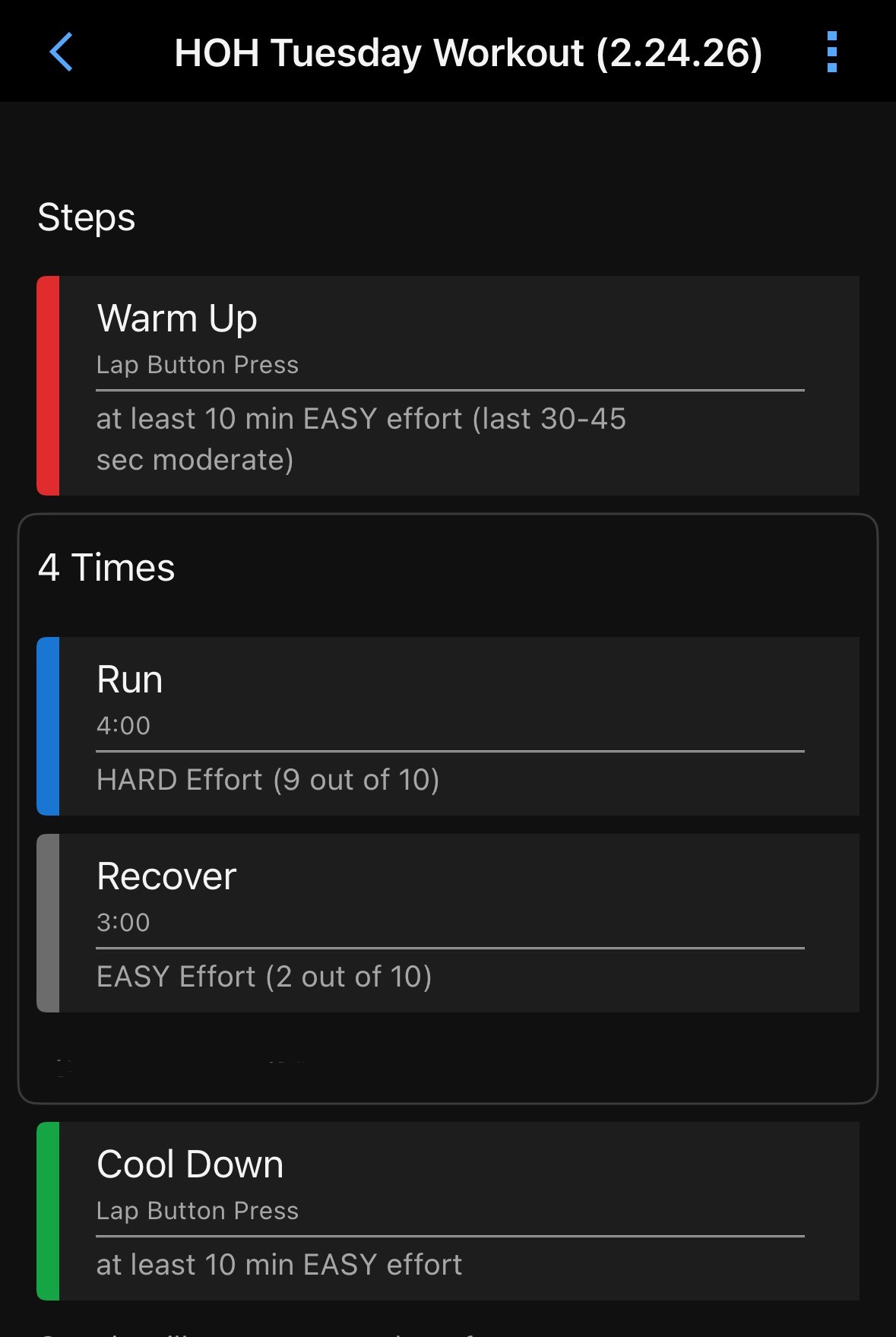
You can find the workout below along with our effort guide and an
attached screenshot of how I programmed the workout into my Garmin.
Tuesday Speedwork (2.24.26):
Warmup: at least 10 min easy effort w/dynamic exercises: last 30-45
seconds should be at a moderate effort
4 times:
4 min hard effort (think 9 on a 10-scale)
3 min easy effort (think 2 on a 10-scale)
Cooldown: at least 10 min easy effort
About the Workout:
THIS
WORKOUT IS GOING TO BE HARD! Show up hydrated, fueled, and ready
to kick some ass (or have yours kicked) for 45 minutes, or so.
v
Instead of adding an additional moderate
effort to transition from the warmup into the workout, plan to run the last 30-45
seconds of the warmup at a moderate effort to transition directly into the first set of
intervals.
v
Try to hold those 4 minute intervals at a hard
effort; a modification could be to treat it as a progression from moderately
hard to hard effort. The longer you can hold that hard effort, the better the
impact will have on your VO2Max
v
It is okay to start the 3 minute intervals as
a walk, but you should be easy jogging 60-90 seconds into the interval.
v
There are no additional
recoveries between sets; sip your water, stretch, fix your breathing &
form on those easy intervals
v
EVERYONE is to circle to the back of the group (or as
close as possible) during the easy intervals. This promotes inclusion and team
atmosphere and allows me to check in on everyone.
v
Remember that we run
these workouts on effort, NOT numerical pace and these efforts
are relevant to you, and you alone- and as I previously mentioned, many factors
impact how they feel from run to run… and that is okay!
v
Since we will be on open roads, everyone must have lights/reflective gear.
v
Always run on the left
side of the road, facing oncoming traffic; always move into single file when cars pass.
Effort Guide:
Easy Effort: should be conversational in that
you should be able to hold a conversation or sing a song without feeling too
out of breath. 80% of your runs should be run at this effort.
Moderate Effort: ~ 1 minute per mile faster than easy
pace
A little more challenging, but you can still converse- in a few
sentences.
Tempo Effort: ~ 1.5 minutes per mile faster
than easy pace
A little more challenging than moderate, but you can still converse- in a
few sentences.
Moderately Hard Effort: ~ 2 minutes per mile faster than
easy pace
More challenging with labored breathing. This effort is sustainable for
30-60 minutes. You should only be able to speak a sentence or two.
Hard Effort: ~ 2.5 – 3 minutes per mile
faster than easy pace
Quickly uncomfortable, and you shouldn't be able to say more than a few
words.
Harder Effort is uncomfortable, your breathing
should be quite labored, and you shouldn't be able to say more than a word (if
any).
LOOKING AHEAD:
Saturday (2/28): LMS at 8:30am for our long training run
Tuesday (3/3): Location TBD at 5:45pm for our workout.
Please make good choices and keep yourself properly hydrated today
and tomorrow. While you’re at it make sure you are feeding your body
appropriately ahead of tomorrow’s workout. Ideally, up to 3 hours before the workout, plan for a 2:1 or 3:1 (carbs to protein) ratio to optimize your glycogen
stores, increase muscle repair, and delay fatigue without causing stomach distress.
Consuming another 3:1 (carbs to protein) ratio within 30-60 minutes after the workout will assist
in muscle repair and recovery while replenishing glycogen stores.
So excited to see you tomorrow evening in the LMS Complex parking
lot at 5:45pm with your lights/reflective gear on.
Have an amazing day!
Coach Kristen
—