
HOH Tuesday Workout (1.13.26)
Hello and
welcome to another week!
It was a great weekend to get outdoors for some fresh air- I hope
you had the opportunity to do so!
Even though Lights on the Lake officially ends this evening (leaving
the Parkway runnable, again), I’m concerned that the forecasted gusts of wind
will be more brutal along the lake than the village. With this in mind, we are
going to meet tomorrow at 5:45pm in the LMS parking lot (located HERE! off the intersection of 7th
& Hickory St. in Liverpool) for our speed workout.
Please come prepared in your lights/reflective gear,
hydrated & fueled, and ready to work hard!
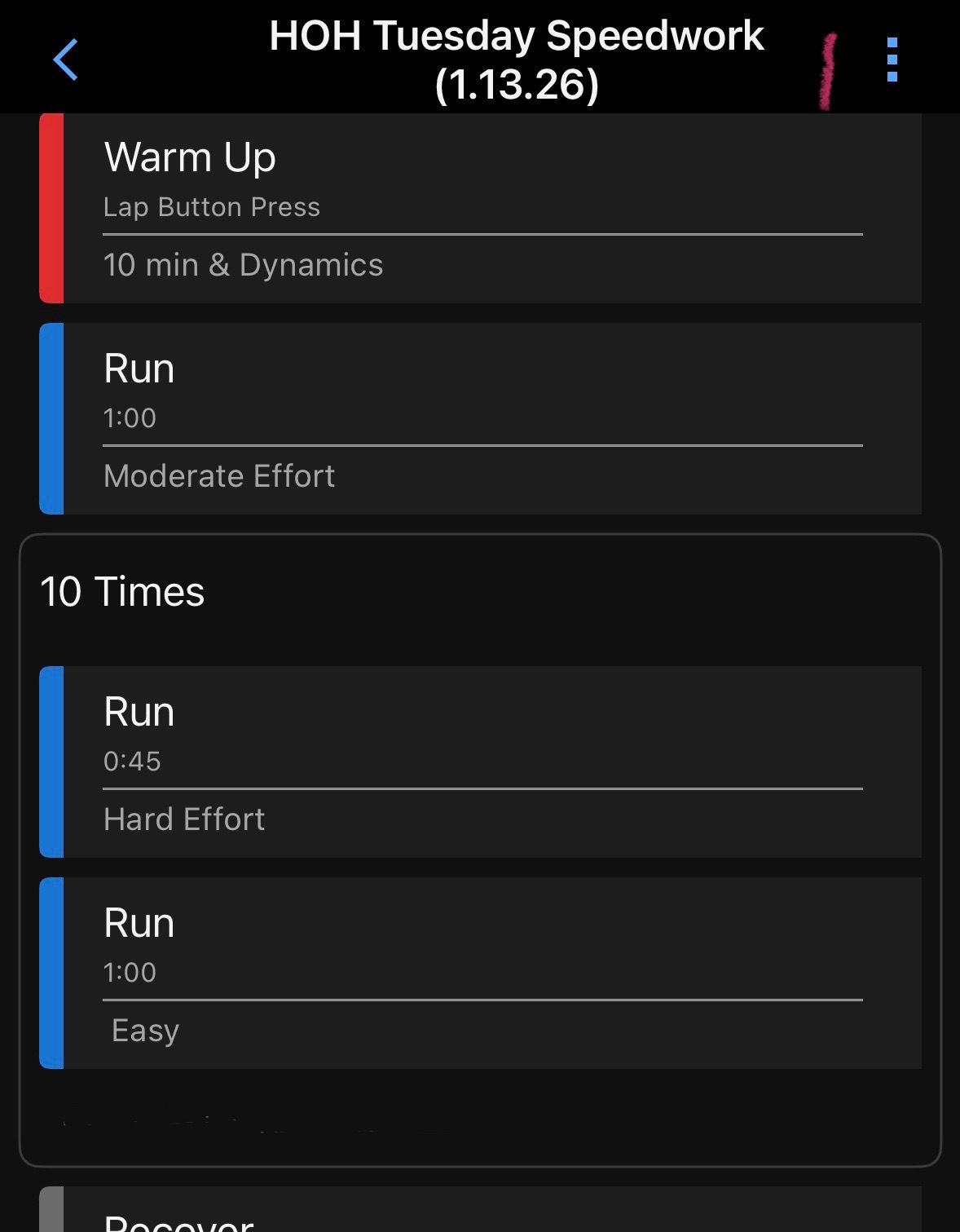
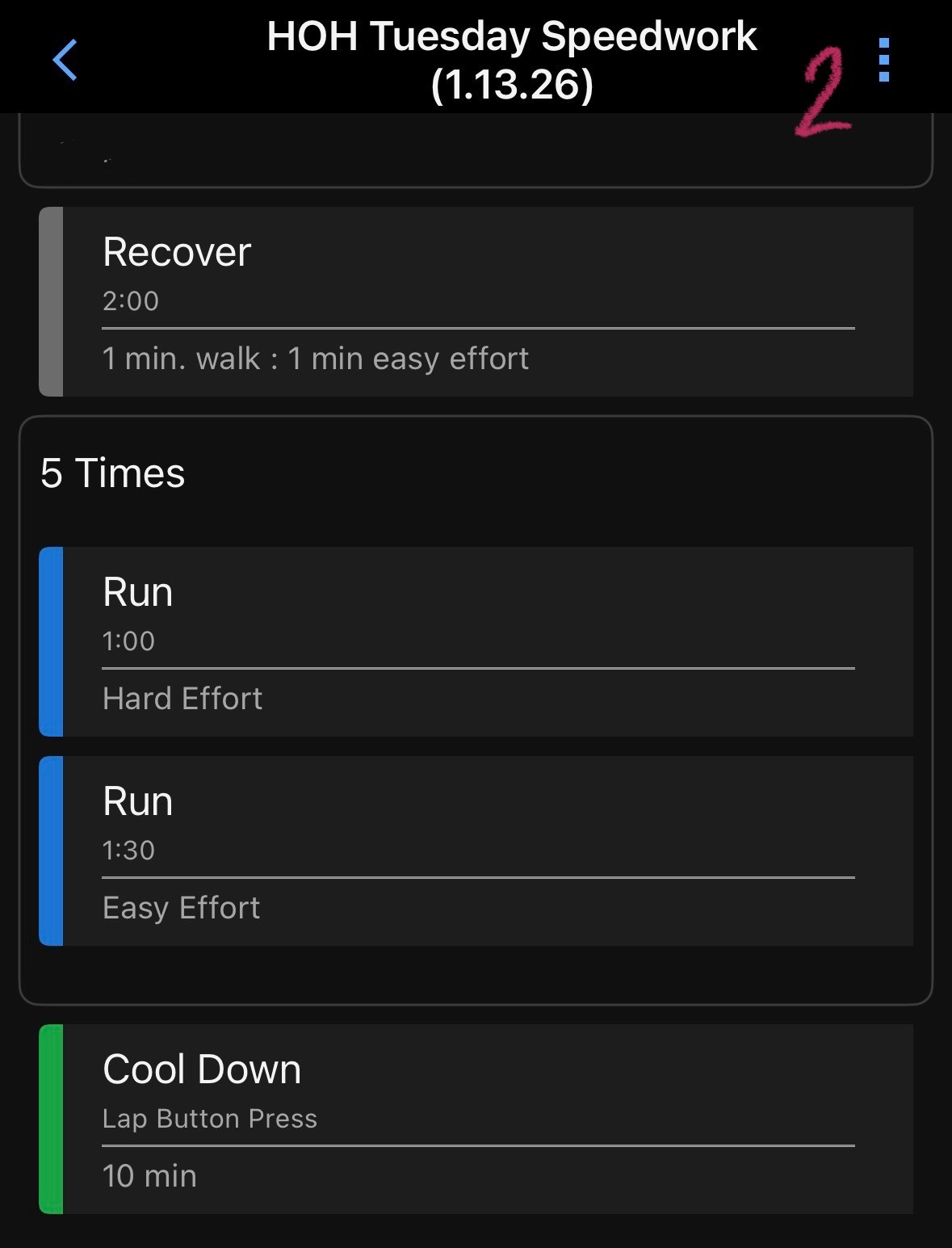
You can find tomorrow’s workout and our handy-dandy effort guide below along
with 2 screenshots attached of how I programmed the workout into my Garmin
watch.
Tuesday Speed Workout
(1.13.26):
Warmup: at least 10 min at an easy effort with dynamic exercises
1 min moderate effort (think 3-4 on a 10 scale)
10 times: 45 sec hard effort/60 sec easy effort
2 min recovery (1 min walk/1 min easy)
5 times: 1 min hard effort/90 sec easy effort
Cooldown: at least 10 min at an easy effort
About the Workout:
v
Warmups and Cooldowns should be jogged at an easy
effort.
v
The easy intervals are scheduled as runs in my Garmin
(see screenshot) and should be jogged at an easy effort (2 on a 10-scale), not walked.
If you absolutely need to, you can begin them as walks, but you should jog
within 10-15 seconds.
v
We will walk the first minute of the recovery
and jog the second minutes at an easy effort (think 2 on a 10-scale).
v
Use the 2 minute recovery to sip your water, adjust
your posture and form, stretch, or regulate your breathing.
v
EVERYONE is to circle to the back of the group (or as close
as possible) on the easy intervals and recovery. This promotes inclusion and
team atmosphere and allows me to check in on everyone.
We will be
doing the workout on the streets in the upper village (probably on Hickory/Birch/6th/7th)
so everyone must stay alert and aware of traffic:
v
Always run against traffic (on the left side of the road) and move
into single file when traffic passes.
v
Yell out to notify fellow teammates of passing
cars.
v
Everyone MUST be visible
by wearing lights/reflective gear/clothing.
Tuesday workouts are
supposed to be hard and uncomfortable!! Growth does not occur in the comfort
zone.
By running these short, hard efforts with small periods of rest
between, you are building your anaerobic threshold. These more intense
intervals help to improve your speed and build your aerobic capacity over time.
What is Anaerobic
Capacity and What is the Benefit?
Anaerobic Capacity is the body’s ability to produce energy without using oxygen during short
durations of high-intensity activities. Unlike running aerobically which uses
oxygen to produce energy for longer durations (such as your long training runs
completed at a conversational pace), running anaerobically relies on the body
to break down carbohydrates (glycogen) stored in your muscles to produce energy.
This energy production process creates lactic acid, a byproduct which can cause
muscle fatigue and soreness.
By training your anaerobic capacity, you help your body become more
efficient at handling that lactic acid buildup which will then delay muscle
fatigue (while running); allowing you to build up endurance and push harder for
longer periods of time. Building your endurance also improves your VO2max (the
amount of oxygen used while exercising), allowing you to increase your cardiac
fitness and pace. These improvements help you become a more efficient athlete.
While training your anaerobic capacity is valuable for improving
speed, power, and increasing your lactate threshold; anaerobic exercise is
strenuous and can lead to muscle damage. Therefore, it should be
done in moderation (only 20% or less of your total amount of weekly exercise should be
done anaerobically) and with proper warmups and cooldowns, before
and after.
Effort Guide:
Easy
Effort: should be conversational in that you should be able to hold
a conversation or sing a song without feeling too out of breath. 80% of your
runs should be run at this effort.
Moderate
Effort: ~ 1 minute per mile faster than easy pace
A little more challenging, but you can
still converse- in a few sentences.
Tempo
Effort: ~ 1.5 minutes per mile faster than easy pace
A little more challenging than
moderate, but you can still converse- in a few sentences.
Moderately
Hard Effort: ~ 2 minutes per mile faster than easy pace
More challenging with labored
breathing. This effort is sustainable for 30-60 minutes. You should only be
able to speak a sentence or two.
Hard
Effort: ~ 2.5 – 3 minutes per mile faster than easy pace
Quickly uncomfortable, and you
shouldn't be able to say more than a few words.
Harder
Effort is uncomfortable, your breathing should be quite labored,
and you shouldn't be able to say more than a word (if any).
LOOKING AHEAD:
Saturday (1/17): Meet in the LMS complex parking lot (off Hickory St.) at 8:30am for
our long training run (planning for 3-6 miles).
Tuesday (1/20): Meet in
the LMS complex parking lot (off Hickory St.) at 5:45pm for our
workout.
Please stay on top of your hydration and carbohydrate and protein intake (not just today and tomorrow, but regularly).
In fact, don’t take my word for it; if you’re curious if increasing your carbs
ahead of exercise/running actually helps your performance, ask Vicky about her
experience 😊
I cannot wait to see you tomorrow evening at 5:45pm (at LMS) with your
lights/reflective gear!
Have a great afternoon!
Coach Kristen
—